Analyzing the Vercel & Context.ai Security Incident: Third-Party Trust Chain Risks
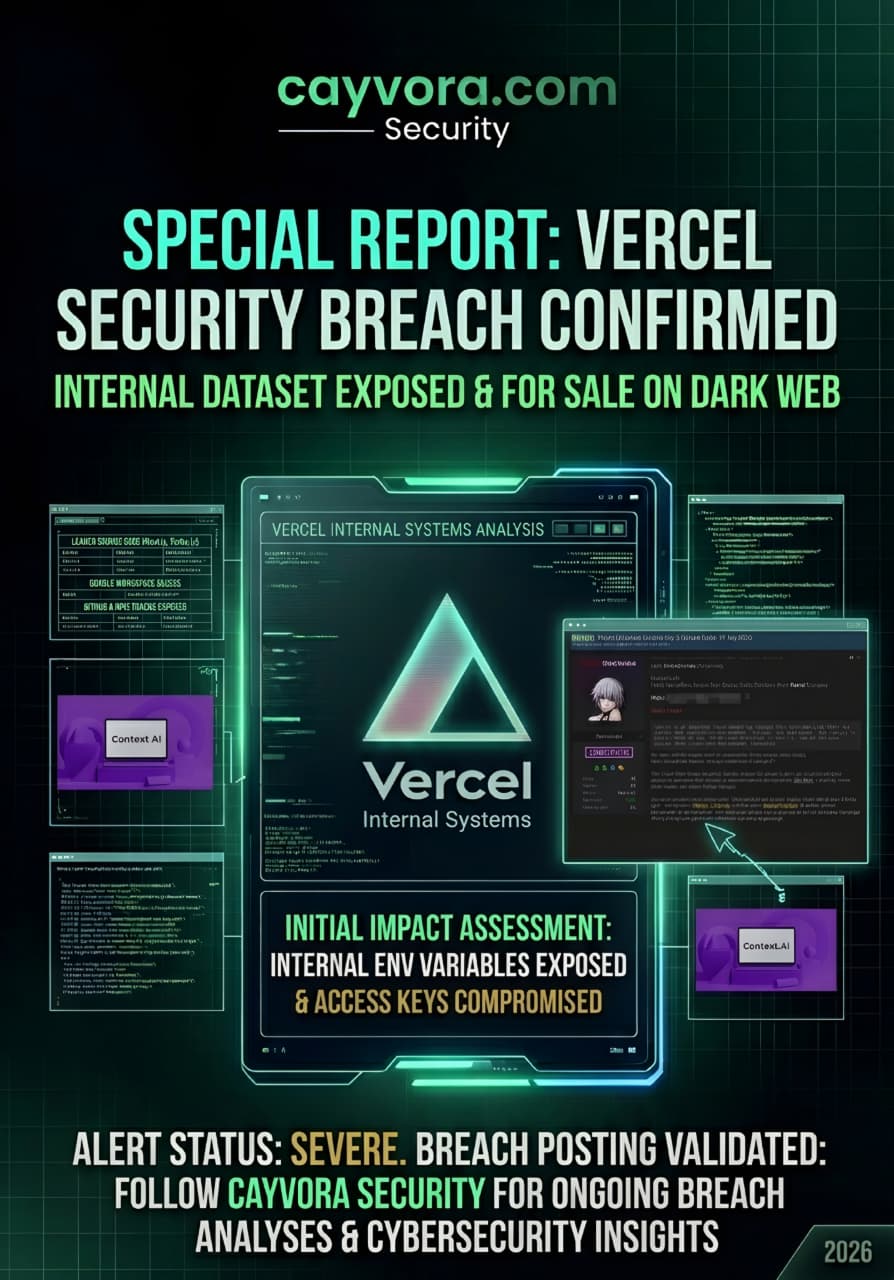
Cloud hosting giant Vercel recently faced a significant security compromise that was traced back to a third-party integration: Context.ai. By exploiting a vulnerability in how third-party tools access internal environments, attackers managed to compromise an employee account, leading to the exposure of internal API keys and sensitive database credentials. This incident serves as a critical warning about the risks of third-party "Trust Chains" in modern DevOps workflows.
Alert Status: SEVERE — Internal environment variables exposed and access keys compromised. Breach posting validated by Cayvora Security.
How the Attack Unfolded
The attack vector exploited the trust relationship between Vercel's internal infrastructure and the Context.ai integration:
- Initial Access via Third-Party Integration: Context.ai, an AI-powered analytics tool, had authorized access to certain Vercel internal environments through OAuth tokens and API permissions granted during integration setup.
- Credential Harvesting: Attackers compromised Context.ai's access tokens—likely through a vulnerability in Context.ai's own infrastructure—and used these tokens to authenticate against Vercel's internal API endpoints.
- Lateral Movement: With valid API tokens, the attackers gained access to internal environment variables, including database connection strings, internal service API keys, and employee account credentials stored in the environment.
- Data Exfiltration: The compromised credentials were used to access internal systems, and the extracted data—including source code references, internal API keys, and database credentials—appeared on Dark Web marketplaces.
What Was Exposed
Based on Cayvora Security's analysis of the breach data:
- Internal API Keys: Service-to-service authentication tokens used within Vercel's microservices architecture.
- Database Credentials: Connection strings and authentication details for internal databases, potentially including customer deployment metadata.
- Employee Account Data: Internal employee identifiers and access tokens that could facilitate further lateral movement within Vercel's infrastructure.
- Environment Variables: Configuration data from internal staging and production environments, including secrets that should never be exposed externally.
Understanding Trust Chain Attacks
This incident highlights a growing class of attacks known as Trust Chain Exploitation. In modern cloud-native architectures, organizations integrate dozens of third-party services—each with varying levels of access to internal systems:
- OAuth Token Scope Creep: Third-party integrations often request broad OAuth scopes during setup. Organizations rarely audit these permissions after initial configuration, leaving overly permissive access in place.
- Transitive Trust: When Service A trusts Service B, and Service B trusts Service C, an attacker who compromises Service C can potentially reach Service A. This transitive trust problem is rampant in DevOps toolchains.
- Shared Secrets in CI/CD: CI/CD pipelines (GitHub Actions, GitLab CI, Vercel deployments) often inject secrets as environment variables. If a third-party tool has access to the CI/CD environment, it inherits access to those secrets.
Defensive Recommendations
Organizations relying on cloud platforms and third-party integrations must implement the following controls:
- Audit Third-Party Access Regularly: Conduct quarterly reviews of all third-party OAuth grants, API tokens, and integration permissions. Revoke any that are no longer actively needed.
- Apply Principle of Least Privilege (PoLP): Ensure each third-party integration has the minimum permissions required for its function. Never grant admin-level or broad-scope access to third-party tools.
- Segment Secrets by Environment: Use dedicated secrets managers (HashiCorp Vault, AWS Secrets Manager) and never store production secrets in environments accessible to third-party integrations.
- Implement Token Rotation: Automatically rotate API tokens and credentials on a regular schedule (minimum every 90 days). Implement short-lived tokens where possible.
- Monitor for Anomalous API Usage: Deploy API monitoring solutions that alert on unusual access patterns—such as a third-party integration suddenly accessing endpoints it has never used before.
- Zero Trust for Internal Services: Even internal services should authenticate and authorize every request. Do not assume that traffic from a trusted integration is inherently safe.
Lessons for the Moroccan Cloud Ecosystem
As Moroccan businesses increasingly adopt cloud platforms like Vercel, AWS, and Azure for their digital transformation, the risks of trust chain attacks become directly relevant:
- Local SaaS Integrations: Moroccan fintech and e-commerce companies frequently integrate third-party payment processors, analytics tools, and marketing platforms—each creating potential trust chain vulnerabilities.
- CNDP Data Protection: Under Loi 09-08, companies are responsible for protecting personal data even when it is processed by third-party services. A trust chain breach that exposes customer data will trigger CNDP compliance obligations.
- Supply Chain Security Auditing: Before integrating any third-party service, conduct a security assessment of the vendor's own security posture. Request SOC 2 Type II reports and penetration test results.
Conclusion
The Vercel/Context.ai incident demonstrates that your security perimeter extends to every third-party service you integrate. At Cayvora Security, we specialize in cloud security audits that map your entire third-party trust chain and identify hidden risks before attackers do. Your cloud infrastructure is only as secure as its weakest integration.